
Ask three firms what a driveway costs in Middleton and you can get three numbers that look like they are for different jobs, because they usually are. The honest answer for 2026 sits somewhere between £45 and £200 a square metre installed, which is a wide enough spread to be useless on its own. A two-car front around here is roughly 45 square metres, so that range is the difference between a £2,000 drive and a £9,000 one. What decides where you land is partly the surface you pick and mostly what happens before the surface arrives. On a block paved drive we would normally expect about 40 per cent of the bill to be groundwork and base, 35 per cent the material and laying, and the rest edging, drainage, plant and tipping. Which is to say the expensive part is the part you will never see again after week one. Here is the whole thing priced from the digging end, with the four surfaces side by side and two worked examples on real Middleton fronts.
Why a driveway quote is mostly groundworks
The bit you choose from a brochure is the thin layer on top. Under a finished driveway in Middleton there is a compacted stone raft doing the structural work, and the depth of that raft is what decides whether the drive is still flat in fifteen years. Nobody photographs it, nobody chooses the colour of it, and it is where most of your money goes.
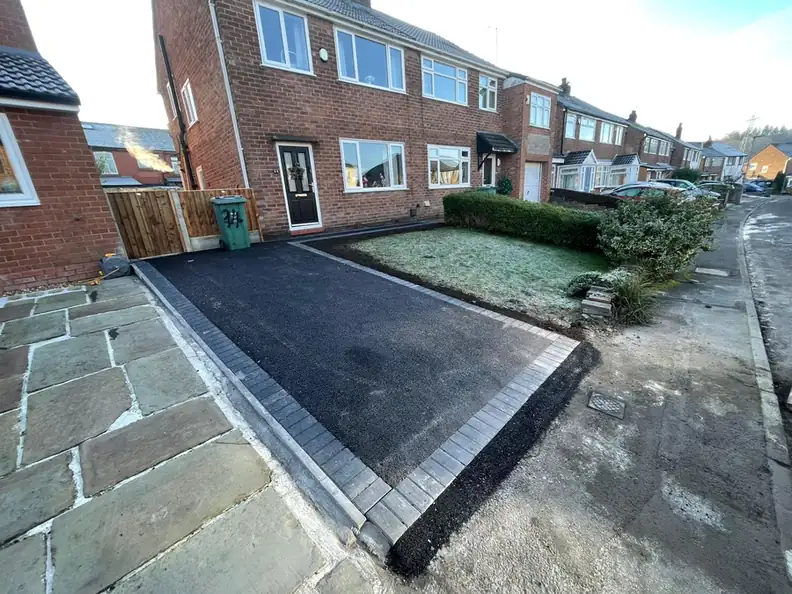
That matters more here than it does in parts of the country sitting on gravel or chalk. Middleton’s ground is the Irk valley’s legacy: heavy glacial clay, bands of sand where the old brooks ran, and in pockets around Boarshaw and Rhodes a layer of made ground from the mills and terraces that were cleared decades ago. Clay swells when it is wet and shrinks when it dries, and with somewhere north of 850mm of rain landing on north Manchester in a year it is wet far more often than it is dry. Build 100mm of stone on that and the car will find the weak spot inside two winters.
So when you compare quotes, the surface is the least useful thing to compare. Two firms quoting the same block at the same rate can be £1,500 apart on the same drive and both be pricing accurately, because one has allowed for 200mm of dig and twenty tonnes out and the other has allowed for scraping the turf off.
Excavation and muck-away, and why the disposal price swings
Nobody enjoys paying for a hole. It is still the line no one can price with real certainty until the breaker has been through the old surface. The volume itself is simple arithmetic. Take 45 square metres, dig to 250mm, and you have around 11 cubic metres to shift. Excavated clay weighs roughly 1.8 to 2 tonnes a cubic metre once it has rain in it, so that is about 20 tonnes leaving site - a full 8-wheel grab wagon, or three or four skips if there is nowhere to stand a wagon.
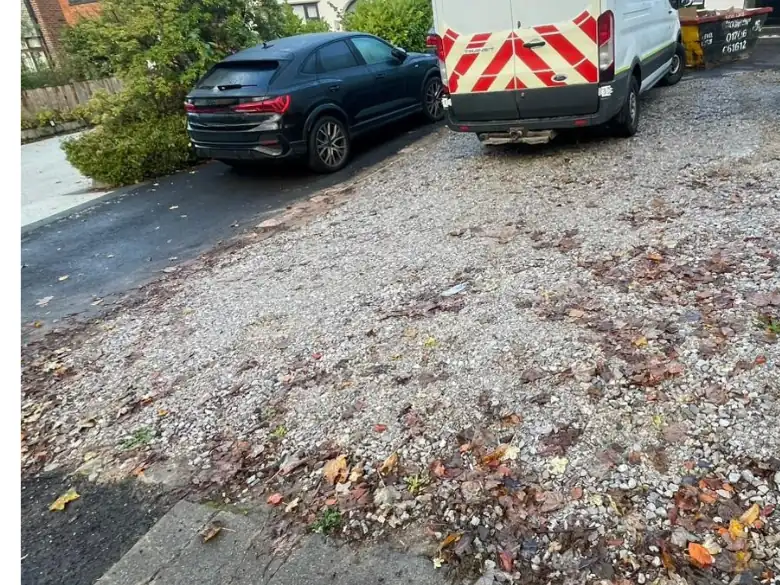
What you cannot predict is the tip rate, because that depends on what comes out. Clean subsoil and clay is the cheap end. Mixed rubble, old concrete and brick costs more per tonne because it has to be sorted. Ash and clinker fill, which turns up under a lot of pre-war Middleton fronts where an outhouse or a coal store once stood, costs more again. And tarmac laid before the 1980s can contain coal tar, which is classified as hazardous waste and has to go to a licensed site at several times the normal rate. Nobody knows which of those they are dealing with from the pavement.
Two things to ask about, because they cost money and both get skipped. First, whether disposal is in the price or excluded - “muck-away at cost” on a quote means the number you signed is not the number you pay. Second, who is carrying it. Anyone moving waste off your property commercially has to be a registered carrier, and you can look up a firm on the public register of waste carriers, brokers and dealers on GOV.UK. Twenty tonnes of your old drive fly-tipped up a lane off Hollin Lane is still traceable to the address it came from.
Sub-base, membrane and the depth question
Once the hole is open, the sub-base goes in. For a domestic drive taking cars and the occasional van, that is 150 to 200mm of MOT Type 1 limestone, laid in layers and whacked with a plate or a roller between each one rather than tipped in one go and driven over. On clay it wants a geotextile membrane underneath to stop the fines working up into the stone, which is a £2 to £3 a square metre item that doubles the working life of everything above it.
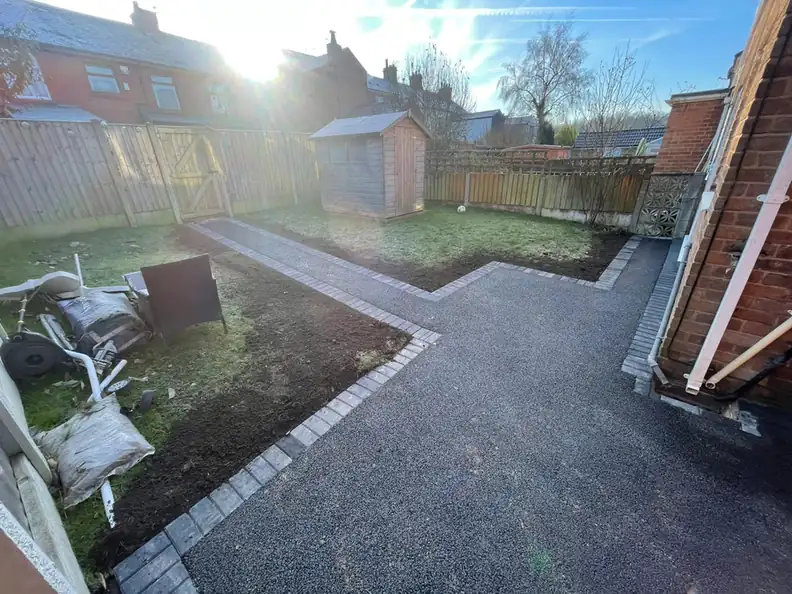
Where a drive needs to be permeable - and most new front drives do, for reasons covered below - the recipe changes. The stone becomes a clean, open-graded aggregate rather than Type 1, because Type 1 contains fines that clog, and the depth usually goes up rather than down since the base is now storing water as well as spreading load. That is a genuine extra cost of £8 to £15 a square metre over a standard base, and it is one of the reasons a resin quote is not simply a block quote with a different top layer.
Three things to look for when you read a quote, then. Base depth in millimetres. Type 1 or open-graded. Membrane, yes or no. If a quote says none of that, it is not a specification, it is a price.
The four surfaces compared
Here is where the choosing actually happens. All four of these are laid on the same kind of base, so the price differences below are the surface and the labour on top of it, not the engineering underneath.
| Tarmac | Block paving | Imprinted concrete | Resin bound | |
|---|---|---|---|---|
| Installed cost per m² | £45 - £65 | £60 - £90 | £65 - £90 | £70 - £200 |
| Realistic lifespan | 15 - 20 years | 20 - 25 years | 15 - 20 years | 15 - 20 years |
| Maintenance | Occasional patching, no sealing needed | Re-sanding joints, weeding, odd block lift | Wash and reseal every 3 - 5 years | Wash down, no sealing |
| Drainage | Impermeable, needs a channel or fall to soft ground | Permeable if laid as a permeable system, otherwise not | Impermeable, needs a channel | Porous through the surface |
| How it fails | Ruts and cracks where the car sits, edges crumble | Spreads sideways, sinks in wheel tracks, joints weed up | Cracks through the slab, colour fades, goes slippery | Loses stones if the resin ratio or the weather was wrong |
| Best suited to | Long or large drives where cost per metre decides it | Traditional brick houses, drives needing repairs later | Continuous pattern with no joints, sound ground | Small and medium fronts, drainage compliance, clean finish |
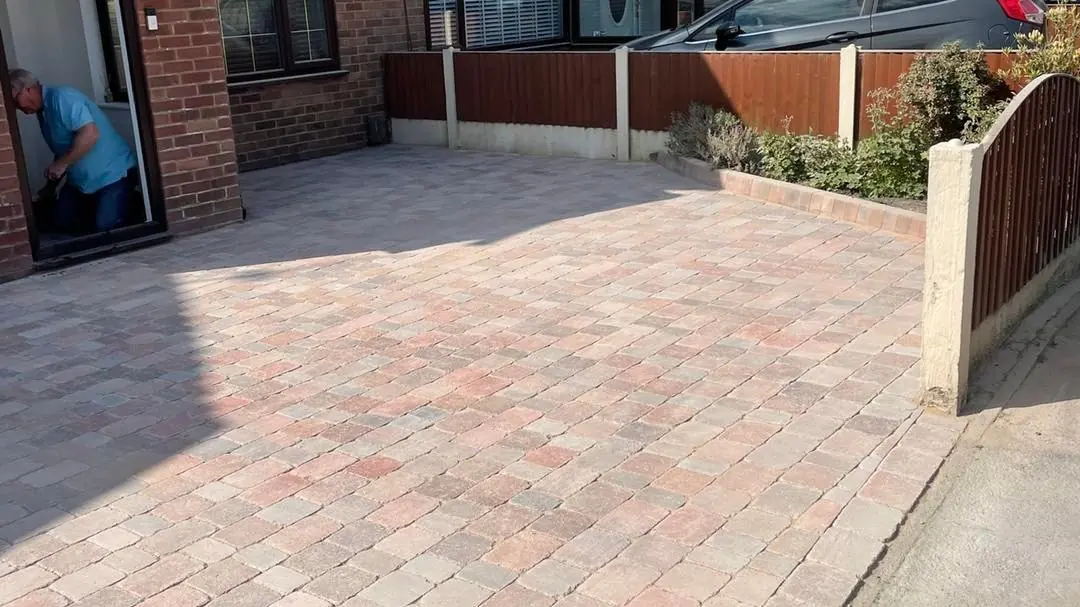
A few things that table cannot say. Block paving is the only one of the four you can properly repair - lift twenty blocks, fix what is underneath, put the same blocks back and it is invisible. That is worth real money on a drive with a water main or a gas service running under it. Tarmac is the cheapest sound surface anyone can sell you, and the reason it has a poor reputation is that it is also the easiest to lay badly: one thin hot course on top of the old drive looks identical on day one and breaks up by the second winter. Imprinted concrete has no joints at all, which people love for the first decade and regret when a crack appears, because you cannot take a crack out of a slab. Resin is the one where the price band is widest, because the low end is a simple rectangle over a sound existing slab and the high end is a curved sweep with a full permeable build underneath.
Edgings, drainage and the bit at the pavement
Every drive needs something holding its perimeter, and it is not a small line on the quote: budget roughly £18 to £30 a metre for aluminium restraint, £30 to £45 for a block soldier course and up to £90 a metre for granite setts, all including the concrete bed. We have written about the whole perimeter in detail in what driveway edging, kerbs, walls and gates cost in Middleton, so it is enough here to say that the edge is priced per metre while the surface is priced per square metre, which is why two small drives cost more than one big one of the same total area.
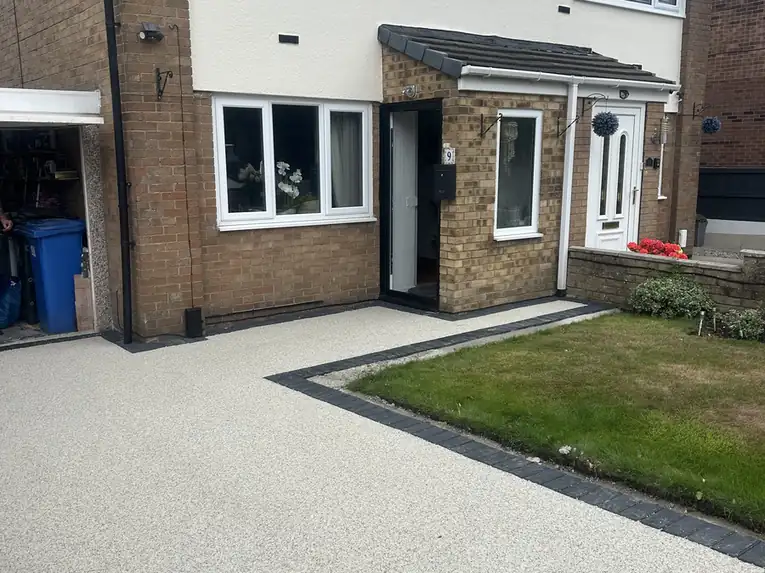
Drainage is the other perimeter cost, and it is not optional. Since October 2008, any front garden hard surface over five square metres has had to be permeable or drain to your own land to count as permitted development, as set out in the government’s guidance on permeable surfacing of front gardens. Meeting it costs either nothing extra, if you pick a porous surface, or £200 to £600 for a linear channel and a connection, or more if a soakaway has to be dug. Our guide to driveway planning permission in Greater Manchester goes through the rules properly.
If you are going from no drive to a drive, there is one more cost that is nothing to do with us. Middleton sits in the Metropolitan Borough of Rochdale, so the vehicle crossing is Rochdale Borough Council’s to approve and to build, and they price each one individually rather than publishing a flat fee. Their dropped kerb guidance is worth reading before you commit to a layout, because they will not approve a crossing unless the parking space behind it is deep enough - 4.8 metres if a car can drive on and off from either end, 5.5 metres if something blocks one end. On a shallow Victorian front off Oldham Road that requirement sometimes decides the shape of the whole drive, and therefore its area, and therefore its price.
Two worked examples on Middleton sizes
Numbers per square metre only become useful once they are attached to a real front. Both of these assume clay ground, no asbestos or tar surprises, a wagon can get within reach, and VAT at 20 per cent is included.
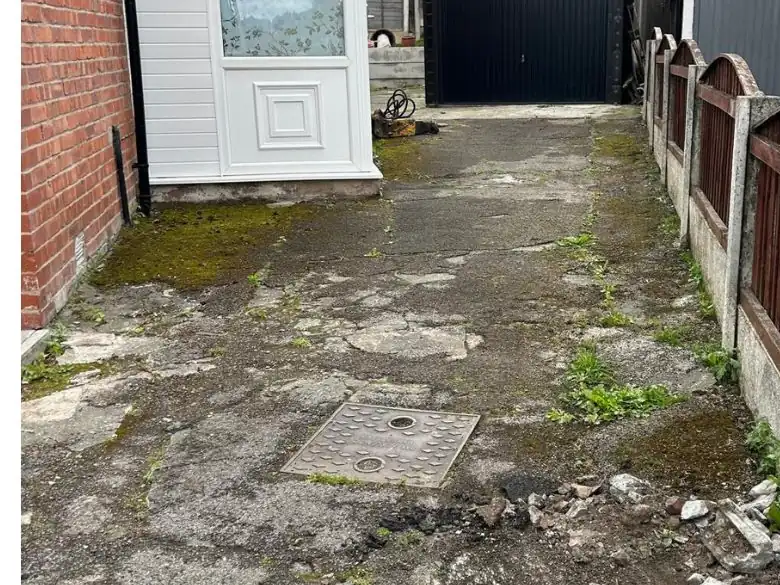
A 1930s semi in Alkrington, two cars, 42 square metres
Existing surface is a thin 1980s concrete slab with a crack across it and a strip of lawn either side. Break out and remove around 18 tonnes, dig to 250mm, membrane, 200mm of stone, a soldier course down both sides and a channel at the threshold. In block paving that lands around £3,200 to £4,200 all in. The same drive in tarmac with a block border is nearer £2,400 to £3,100. In resin bound over a full permeable base, £4,000 to £5,400, and the channel comes out of the spec because the surface handles it.
A bay-fronted terrace off Manchester Old Road, one car, 19 square metres
Small area, but a low garden wall to take down, a gate pillar to rebuild, and an access where everything comes out by wheelbarrow to the wagon. The perimeter is nearly as long as the drive is wide, so edging is a bigger share than usual. Resin or block both come out around £1,900 to £2,600 - and note the cost per square metre is far higher than the semi above, because the fixed costs of a job do not shrink with the area. This is why quoting a small drive at the same rate as a big one is either a mistake or a surface that is about to be laid thin.
What a cheap quote is missing
When someone shows us a price we cannot get near, it is almost never because the other firm buys stone cheaper. Nine times in ten it is one of these three.
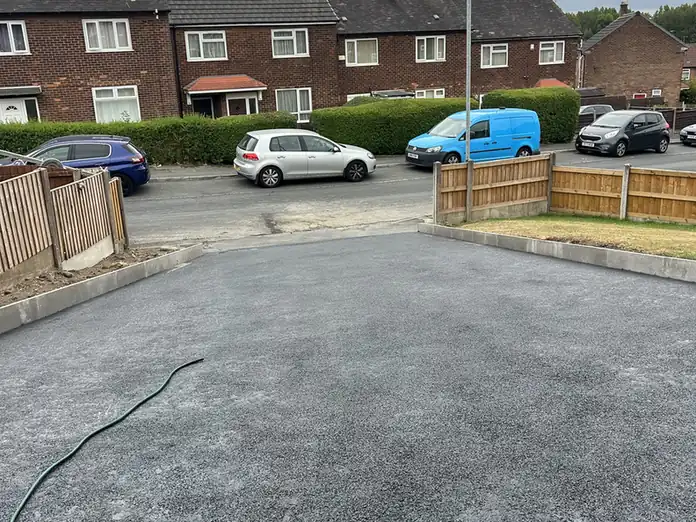
The dig depth. A drive scraped to 100mm and topped with stone costs half what a 250mm build costs, and there is no way to tell from the finished surface. The disposal. Spoil dropped on the back garden, split between neighbours’ skips, or driven away by someone who is not a registered carrier does not appear as a cost because it has not been paid for. And the edge. Restraints bedded in sand rather than concrete save a day’s work and a tonne of mix, and the drive starts fanning out at the front within three years.
There is a fourth, which is the doorstep tarmac offer - the van with material “left over from a job round the corner”. We have covered how to filter that out in choosing a driveway company in Manchester, and the short version is that hot tarmac is booked from a plant for a named day and cannot be left over.
When you can skip the full dig, and when you cannot
The cheapest good drive is one where the base already exists and is sound, because you are buying a surface rather than a rebuild. That is a real saving, often £1,000 to £2,000 on a two-car front, and we quote for it whenever the ground allows.
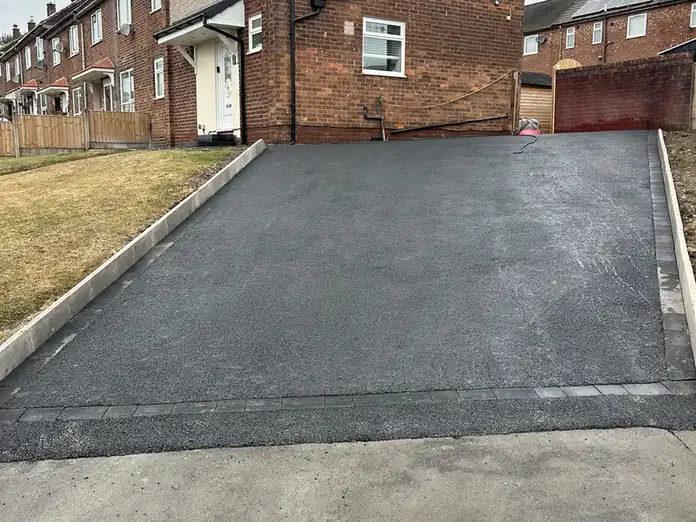
It works when the existing slab is uncracked, still bedded down with no hollow sound under the wheel tracks, falling away from the house, and thick enough to have been laid properly in the first place. Resin bound stone bonds well to concrete, and a two-course tarmac overlay on a sound slab is a perfectly respectable job.
It does not work when the slab has a structural crack, when a corner has dropped, when the levels would end up above the damp course or over an air brick, or when the reason the old drive failed was the ground rather than the surface. Laying something thin and stuck down over a slab that moves buys you a year or two, and then the crack comes through the new surface in the same place it was before. We go through how to tell the difference in why printed concrete driveways in Middleton crack, fade and go slippery, which is the same judgement call from the other direction.
If you want a number for your own front rather than a range, the driveway cost page has a per-metre estimator, and a site visit turns that into a fixed written price with the dig depth, the disposal and the edging spec on it.
Frequently asked questions
How much does a new driveway cost in Middleton in 2026?
Between about £45 and £200 a square metre installed, depending entirely on the surface. Tarmac on a proper base is £45 to £65, block paving £60 to £90, imprinted concrete £65 to £90 and resin bound £70 to £200. A typical two-car front in Middleton is around 45 square metres, so that is roughly £2,000 at the cheap end and £6,000 to £9,000 for the surfaces most people pick. Those are guide ranges for sound ground and reasonable access, and every one of them assumes excavation, sub-base, edging and disposal are included.
Why is the excavation the most unpredictable part of a driveway quote?
Because nobody knows what is under the old surface until it comes up. Dig 45 square metres to 250mm and you have around 11 cubic metres to shift, which is roughly 20 tonnes of wet Middleton clay. If it is clean subsoil it goes out cheaply. If it is mixed hardcore, old concrete, ash fill from a demolished outbuilding or tarmac old enough to contain coal tar, the tip charges more per tonne and the load has to be classified properly before it leaves. That is the line that moves, and it is the line cheap quotes leave blank.
Is resin worth double the price of tarmac?
It depends what you are buying it for. Resin is porous, so it satisfies the front garden drainage rules without a channel or a soakaway, it has no joints for weeds and it keeps its colour. Tarmac is the cheapest sound surface there is and looks smart with a block border, but it is impermeable, it softens in a hot spell and it goes grey. On a big drive where budget decides it, tarmac wins easily. On a small front where you want it to look finished and drain itself, resin earns the difference.
Do I have to pay VAT on a new driveway?
On a new or replacement drive at an existing house, yes - it is standard rated at 20 per cent, and there is no relief that applies to ordinary domestic paving. What varies is whether a quote shows it. Ask for the figure you will actually pay rather than a subtotal, because a price that looks 20 per cent keener than everyone else's sometimes just has the VAT further down the page.
Can a new driveway go straight over the old one?
Sometimes. A sound, uncracked, properly drained concrete slab will take resin bound stone or a thin tarmac overlay and save you the dig, the disposal and a good chunk of the price. A slab with a structural crack, a sunken corner or an existing drainage problem will not, because anything laid on top follows what the concrete underneath does. Scott checks the slab before quoting either way, and says so on the quote.